 |
| Food Pyramid |
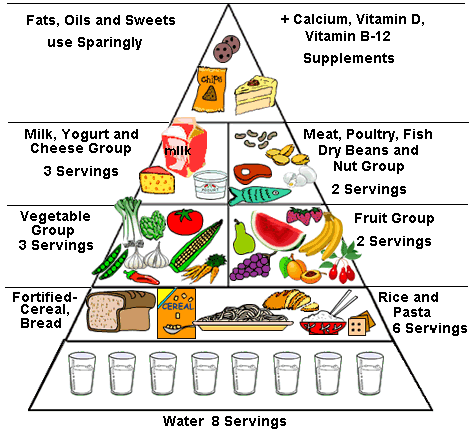
The food that we eat daily is made up of substances called “nutrients” which have a role in the growth of the cells, facilitation of the processes of the body and supplying energy to the body. There are 6 types of nutrients that our body needs to be supplied with in order for it to function properly and be in its best shape. Proteins, such as chicken & eggs, aid in the growth of cells. Fats, which are found in butter & meats, have a function of providing energy to the body. Carbohydrates, such as rice & potatoes, are also a very important source for the body; two additional kinds of carbohydrates are starches & sugars. Our body uses carbohydrates, proteins and fats with the support of vitamins. Minerals make a lot of activities in the body easier. Last but not least: water; it is very important as it is composes our blood, regulates our body temperature & is involved in many more activities. In a food pyramid, different groups of food are grouped together where each group has similar nutrients together. Questions:
- What are the 3 functions of nutrients?
- What are the 6 kinds of nutrients? Give examples of each one.
- What can we find in a food pyramid?
- http://www.whale.to/a/food_pyramid.gif
- Heit, L, Meeks, L (2003). Totally Awesome Health. New York, NY: Macmillan/McGraw-Hill.


Usually information about health is very dull but i found yours to be very useful and concise. I also really liked your background--it's so colorful :)
ReplyDeleteThis paragraph is very interesting.We learn a lot about the different types of nutrients which are decribed very clearly.
ReplyDeleteI think you did a great job with your blog!!
1) they have a role in the growth of cells
ReplyDelete2)
3) grains, fruit, protein, sweets
1.)Nutrients play many roles in the body such as: the growth of cells,providing energy to the body, and regulating our body temperature.
ReplyDelete2.) Proteins [example:eggs], Fats [example:butter], Carbohydrates [example:rice], Minerals, Vitamins,and Water.
3.)Sweets,yogurt,fruit,etc...
1-Growth of cells,providing energy to the body,regulating body temperature(keep us alive:)P).
ReplyDelete2-6 kinds of nutrients:Water
Yes, water is a nutrient. It is the most important nutrient. In fact, your body is approximately 50 to 55 percent water. Your body uses water 24 hours a day. A by-product of the energy production in your body is heat. Water regulates your body temperature by dissipating that heat. Water also carries nutrients to the cells in your body. Water does not produce energy.
Carbohydrates
Carbohydrates are the primary source of energy for your body. Carbohydrates power every system in your body, including your brain, heart, muscles and internal organs.
Carbohydrate can be simple (table sugar, corn syrup) or complex (whole grain). Simple carbohydrates enter your bloodstream very quickly. That is why you get a sugar high when you eat candy. Complex carbohydrates are processed and used more slowly.
Protein
Protein is like the brick and mortar of your body. It is the building blocks that provide the structure for the tissues of your body. Proteins are also used to transport essential elements in your blood stream.
Fats
Fat are our storehouses of energy. When we have excess nutrients in our body, some of it is stored as fat. The primary purpose of fat is energy production.
There are two main types of fats – saturated and unsaturated. Animal fats (meat, butter, lard) are usually saturated fats and contribute to heart disease and cancer. Vegetable fats (olive oil, corn oil) are generally unsaturated fats and are less harmful.
Some fats have been found to be helpful in preventing some cancers and heart disease. These fats called omega-3 fatty acids are found in some fish, especially cold-water fish.
VITAMINS
Vitamins are essential for the regulation of many of the functions of the body. Most vitamins cannot be manufactured by the body and must be obtained from your diet. Vitamins do not produce energy.
MINERALS
Minerals are compounds, obtained from your diet, that combine in several ways to form the structures of your body. For instance, calcium is a mineral that is crucial in the formation and maintenance of your bones. Minerals also help regulate body functions. Minerals do not produce energy.
3-Rice ,cereals,bread,fruits,vegetables,milk,yogurt,cheese,meat,fish,fats,oils,vitamins.